
When an inspection uncovers corrosion, wall thinning, or a crack in a pressure vessel, the immediate instinct is often to replace it. But reactive decisions without engineering evidence are costly and often unnecessary. In many cases, a fitness for service remaining life assessment tells a very different story: the equipment has years of safe, productive life remaining and the data to prove it.
At Ideametrics, we see this situation regularly. Plant operators face pressure to act fast, but the right decision is not always the fastest one. It is the one backed by a rigorous, code-compliant engineering assessment.
This article breaks down how engineers use FFS to make sound run-or-replace decisions, what asset remaining life assessment methods are available, and when replacement is genuinely the right call.
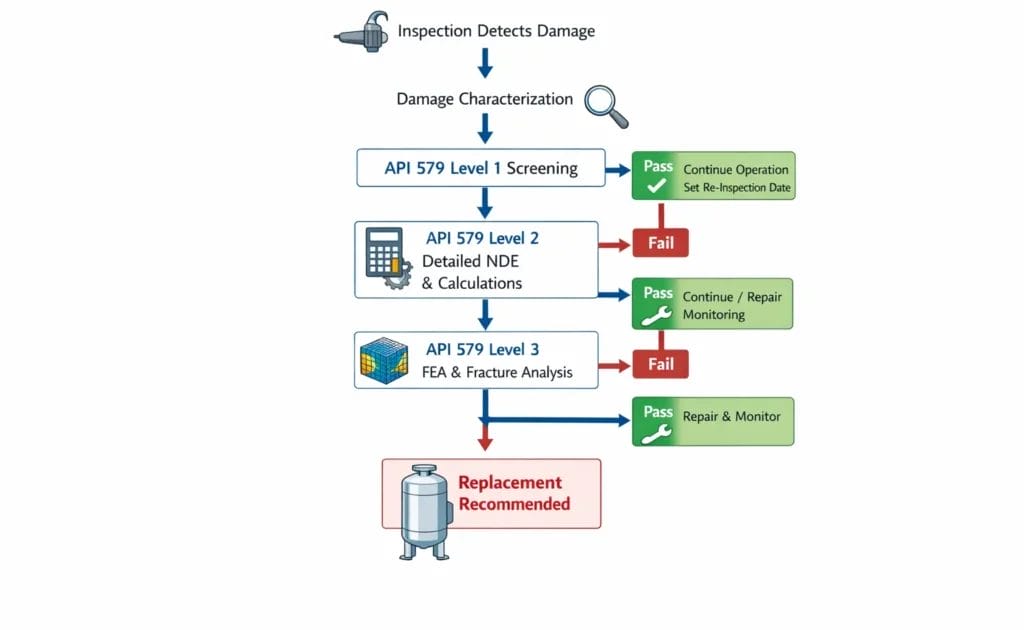
Figure 1: Run–Repair–Replace decision logic using inspection data and API 579 FFS escalation.
Remaining Life Assessment Pressure Vessel: Why It Matters for Plant Safety
Pressure vessels operate under sustained mechanical stress, elevated temperatures, and corrosive process fluids conditions that progressively degrade structural integrity over time. A remaining life assessment for pressure vessels is not a routine paperwork exercise. It is a direct input into plant safety decisions that determine whether a vessel can continue operating without risk of catastrophic failure.
Without a structured assessment, operators are left guessing. That guesswork can lead to two equally dangerous outcomes: premature replacement that wastes capital, or continued operation of a vessel that has silently crossed its safety threshold. Remaining life assessment equipment programs eliminate both risks by replacing assumption with engineering evidence quantifying exactly how much usable life remains and under what operating conditions. For any plant handling hazardous fluids or operating at elevated pressures, this is not optional. It is the foundation of responsible mechanical integrity management.

Figure 2: Typical inspection inputs – UT thickness readings, thickness map, and corrosion thinning profile.
What Is a Fitness for Service Assessment?
A fitness for service assessment (FFS) is a structured engineering evaluation that determines whether equipment containing damage or degradation is safe to continue operating. Rather than asking “does this vessel meet its original design code?”, FFS asks: “Given its current condition, can it still safely perform its intended function?”
The most widely used standard for this is API 579-1/ASME FFS-1, which provides tiered assessment methods covering general metal loss, local thinning, pitting, crack-like flaws, creep damage, fire damage, and more. The standard is also referenced by API 510 (Pressure Vessel Inspection Code), API 570 (Piping), and API 653 (Storage Tanks) making it the industry backbone for in-service equipment integrity decisions.
The Three Assessment Levels
API 579 remaining life assessment uses a progressive, three-level approach:
- Level 1 – Conservative, minimal data required. Can be performed by an inspector. Uses simplified methods and screening criteria.
- Level 2 – Requires more detailed inspection data and engineering calculations. Performed by a qualified engineer.
- Level 3 – Most rigorous. Often involves finite element analysis (FEA). Used when Level 1 and 2 assessments are too conservative or the flaw is complex.
If Level 1 returns an unfavorable result, engineers escalate to Level 2 before considering replacement this tiered approach prevents premature asset retirement.
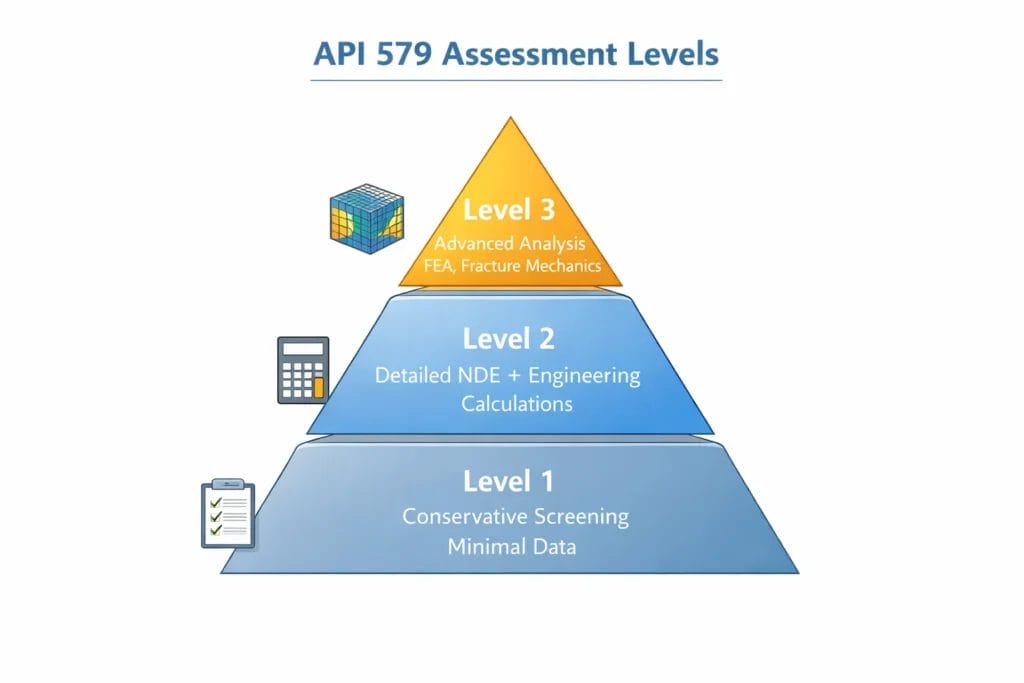
Figure 3: API 579 assessment levels, screening to advanced analysis.
How Remaining Life Assessment for Pressure Vessels and Equipment Works
Remaining life assessment for pressure vessels and other process equipment follows a systematic approach combining inspection data, damage mechanism analysis, and engineering calculations.
Key Inputs for Equipment Remaining Life Calculation
To perform an equipment remaining life calculation, engineers need:
- Actual measured wall thickness (from UT scanning or other NDE)
- Minimum required thickness (calculated from design pressure and material properties)
- Corrosion rate (short-term and long-term)
- Operating pressure and temperature history
- Material specifications and weld records
The Core Formula
The fundamental pressure vessel remaining life estimation formula used in API 579 is:
Remaining Life = (Actual Thickness − Minimum Required Thickness) ÷ Corrosion Rate

Figure 4: Pressure vessel remaining life estimation, linking thickness, corrosion rate, and time.
For example, if a vessel has an actual thickness of 12 mm, a minimum required thickness of 8 mm, and a corrosion rate of 0.4 mm/year, the remaining life is 10 years. This becomes the baseline for inspection interval planning and run-or-replace decisions.
For more complex damage mechanisms fatigue cracking, creep, hydrogen embrittlement, the calculation expands to include crack growth models, cycle counting, and fracture mechanics analysis under API 579 Part 9 (crack-like flaws) or Part 10 (creep).
When Corrosion-Rate Calculations Alone Are Not Enough
Corrosion-based thickness calculations provide a reliable baseline for pressure vessel remaining life estimation, but they do not capture localized stress concentrations or complex structural behavior. Areas such as nozzle junctions, skirt supports, reinforcement pads, and saddle supports experience elevated stresses that cannot be evaluated using thickness formulas alone.
API 579 recognizes this limitation and allows escalation to advanced analysis methods when simplified calculations are insufficient. In such cases, engineers must evaluate whether local stresses exceed allowable limits defined by ASME Section VIII, Division 2.
This ensures that equipment remaining life calculation reflects actual structural performance not just uniform wall thinning assumptions.
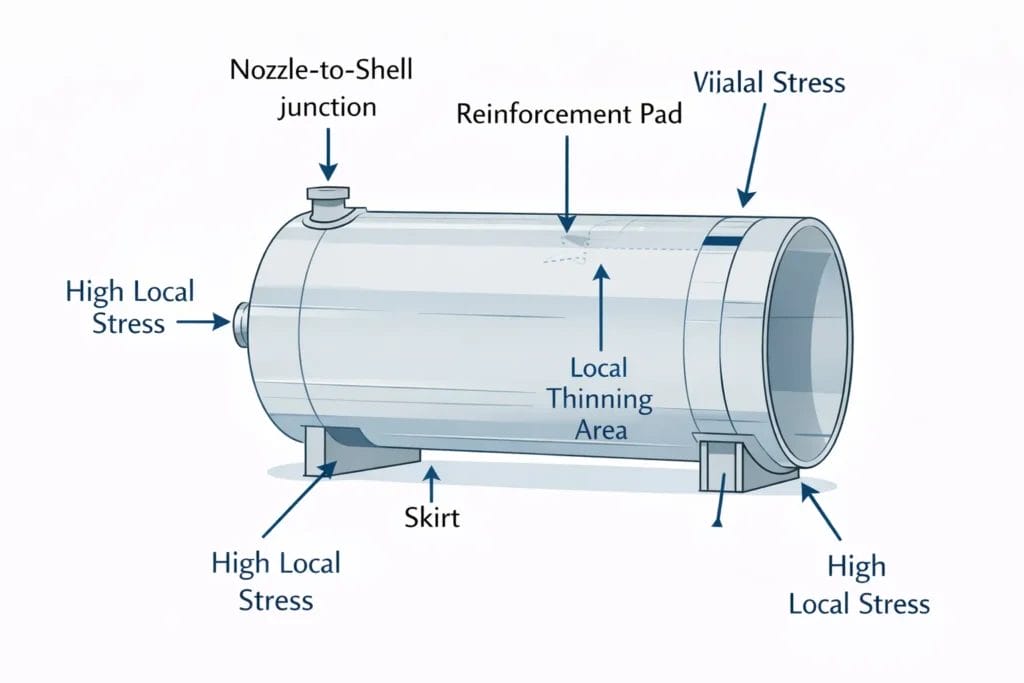
Figure 5: Common high-stress regions requiring advanced assessment beyond thickness methods.
Asset Remaining Life Assessment Methods: Which One Applies?
Not all degradation is the same. Asset remaining life assessment methods are selected based on the active damage mechanism:
| Damage Mechanism | Assessment Method | Governing API 579 Part |
|---|---|---|
| General corrosion / wall thinning | Corrosion rate + t-min calculation | Part 4 |
| Localized metal loss | Point thickness evaluation | Part 5 |
| Pitting corrosion | Pit density and depth analysis | Part 6 |
| Hydrogen blistering / HIC | Crack growth modeling | Part 7 |
| Fatigue cracking | Stress cycle analysis + FEA | Part 9 |
| Creep damage | Time-temperature rupture models | Part 10 |
| Fire damage | Post-fire metallurgical assessment | Part 11 |
Selecting the wrong method leads to either over-conservative replacement decisions or unsafe operation. This is why fitness for service assessment must be performed or supervised by an engineer experienced in both the damage mechanism and the applicable standard.
Fitness for Service vs Replacement: The Engineering Decision
This is the critical juncture every asset owner faces. Below is a detailed comparison to help frame the decision.
Detailed Comparison: Fitness for Service vs Replacement
| Decision Factor | Fitness for Service (FFS) | Equipment Replacement |
|---|---|---|
| Primary Question | Can this equipment safely continue to operate? | What is the cost and timeline of procuring and installing new equipment? |
| Governing Standard | API 579-1 / ASME FFS-1 | Original construction code (ASME VIII, B31.3, etc.) |
| Cost | Engineering assessment + NDE cost; typically 5–20% of replacement cost | Full capital expenditure often $500K to $5M+ for pressure vessels |
| Timeline | Days to weeks for assessment; extended run life with no shutdown | Months of procurement, fabrication, and installation downtime |
| Best Used When | Remaining life is sufficient; damage is localized; material is salvageable | Remaining life is critically short; multiple damage mechanisms are active; repair is impractical |
| Risk Profile | Managed risk with documented engineering basis; ongoing monitoring required | Eliminates existing defects; new design life baseline |
| Inspection Impact | Triggers more frequent inspection intervals based on remaining life | Resets inspection schedule per new construction code |
| Regulatory Acceptance | Recognized by jurisdictional authorities when performed to API 579 | Standard compliance path; no additional justification needed |
| Documentation | Requires detailed FFS report, remediation plan, and monitoring program | Standard MI (Mechanical Integrity) records |
| Outcome | Run as-is, repair and run, or monitor with defined re-inspection date | New asset with full design life |
| Long-Term Cost | Lower short-term; potential for repeat assessments as equipment ages | Higher upfront; lower maintenance burden for years |
| Ideal Candidate | Vessel with localized corrosion, 5–15 years of calculated remaining life | Vessel with less than 2–3 years remaining life, widespread degradation, or obsolete design |
The bottom line: FFS is not about avoiding the inevitable, it is about using engineering data to make the replacement decision at the right time, not prematurely.
When to Replace a Pressure Vessel: Clear Indicators
While FFS can extend asset life significantly, knowing when to replace a pressure vessel is equally important. Replacement is the right decision when:
1. Remaining Life Falls Below Acceptable Thresholds
If the remaining life is shorter than the next planned inspection interval, or falls below regulatory minimums, continued operation cannot be justified.
2. Multiple Damage Mechanisms Are Active Simultaneously
Corrosion combined with active cracking, or creep coupled with fatigue, creates compounding risk that FFS models cannot adequately bound without extreme conservatism that defeats the purpose.
3. Repair Is Not Technically Feasible
Some flaws particularly widespread hydrogen-induced cracking (HIC) or severe pitting across the entire shell cannot be repaired to a standard that restores adequate margin.
4. Operating Conditions Have Changed Significantly
A vessel originally designed for 150 psi and 300°F that is now being pushed to higher pressures or temperatures may no longer meet fitness criteria even after assessment.
5. Total Cost of Ownership Favors Replacement
When the combined cost of repeated assessments, repairs, and increased inspection frequency over five years approaches the replacement cost, replacement delivers better value and less operational risk.
The Role of API 579 in Fitness for Service Remaining Life Assessment
API 579 remaining life assessment is not a one-time exercise, it is an iterative process tied to inspection intervals and operational monitoring. After an FFS assessment:
- Re-inspection date is set based on remaining life (typically half the calculated remaining life)
- In-service monitoring is recommended when remaining life is short or damage progression is uncertain
- Results are documented in an FFS report that becomes part of the equipment’s permanent mechanical integrity record
This creates a defensible, regulator-accepted basis for continued operation far more rigorous than rule-of-thumb judgment calls.
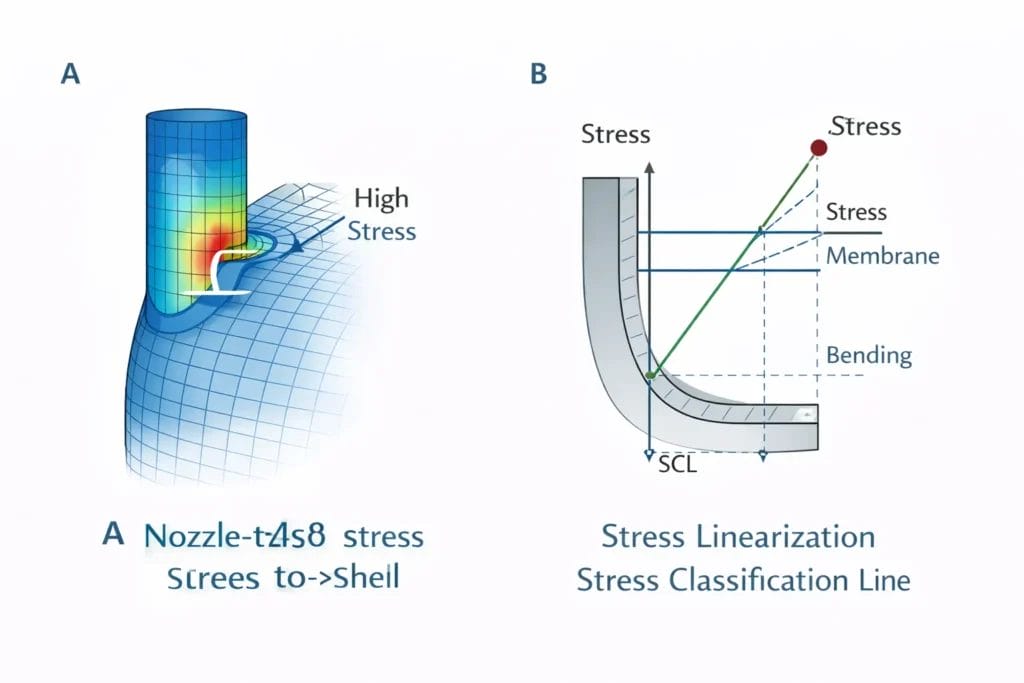
Figure 6: Level 3 FFS – FEA stress contour and stress linearization along a Stress Classification Line (SCL).
Role of Finite Element Analysis (FEA) in API 579 Level 3 Remaining Life Assessment
Finite Element Analysis is the most rigorous method used in API 579 remaining life assessment when damage is localized, geometry is complex, or operating loads create non-uniform stress distribution. Level 3 assessments use FEA to simulate real operating conditions including internal pressure, thermal gradients, wind loads, seismic forces, and support reactions.
This analysis identifies peak stresses, membrane stresses, and bending stresses across critical sections of the vessel. Stress linearization techniques are then applied to verify compliance with ASME allowable stress limits.
FEA is particularly essential for evaluating:
- Nozzle-to-shell junctions
- Skirt-supported vertical vessels
- Thin shells exposed to external pressure
- Equipment with localized corrosion or weld defects
By combining inspection thickness data with structural simulation, engineers can accurately determine whether the vessel remains fit for continued service or requires repair or replacement.
For high-value refinery and petrochemical assets, this approach often extends safe operating life by 5 to 15 years while maintaining full compliance with API 579 and ASME requirements.
Putting It Together: A Practical Engineering Decision Framework
Use this logic flow for fitness for service remaining life assessment decisions:
- Inspection reveals damage – Characterize damage type and severity
- Perform API 579 Level 1 – If acceptable, set inspection interval and continue
- Level 1 fails – Escalate to Level 2 with detailed NDE and engineering calculations
- Level 2 fails – Perform Level 3 (FEA, fracture mechanics) or evaluate repair options
- All levels fail or remaining life is critically short – Replace with engineering justification documented
Every step is documented. Every decision has an engineering basis. That is what distinguishes a sound FFS program from guesswork.
Engineering Case Example: Avoiding Premature Replacement Using FFS
During a scheduled inspection, a refinery separator vessel showed localized corrosion reducing wall thickness near a nozzle region. Initial screening suggested the thickness was approaching minimum allowable limits, triggering replacement consideration.
A detailed fitness for service remaining life assessment was performed using API 579 Level 2, followed by Level 3 FEA to evaluate local stress concentration. The analysis confirmed that structural stresses remained within allowable limits and corrosion progression was slow.
The calculated remaining life exceeded 12 years.
Based on engineering evidence, the vessel continued operating safely with a defined inspection interval, avoiding immediate replacement and saving significant capital expenditure while maintaining full regulatory compliance. This is precisely the kind of outcome that separates data-driven integrity management from reactive, cost-inflated decision-making.
Final Thoughts
The decision between fitness for service vs replacement is never purely financial, it is fundamentally an engineering judgment grounded in inspection data, damage mechanics, and code-compliant analysis. A well-executed fitness for service remaining life assessment using API 579 gives asset owners and integrity engineers the technical foundation to run equipment safely when the evidence supports it, and to replace it with full confidence when the data demands it.
At Ideametrics, our engineering team applies API 579-1/ASME FFS-1 methodology across refinery, petrochemical, and industrial asset portfolios, helping clients avoid premature capital expenditure without compromising safety or regulatory compliance. The cost of a thorough FFS assessment is almost always a fraction of unnecessary replacement. The key is having the right inspection data, the right standard, and engineers who know how to read both.
Looking to assess the remaining life of a pressure vessel or static equipment asset? Connect with the Ideametrics Global engineering team for a fitness for service evaluation tailored to your equipment condition, operating history, and compliance requirements.
Frequently Asked Questions (FAQ)
A remaining life assessment of a pressure vessel is an engineering evaluation that determines how many additional years a vessel can safely operate given its current condition, active damage mechanisms, and operating parameters. It uses inspection data, primarily wall thickness measurements, alongside corrosion rate analysis, fracture mechanics, and code-based calculations to produce a quantified remaining service life. The result directly informs inspection intervals, repair decisions, and replacement planning.
The standard equipment remaining life calculation formula is: Remaining Life = (Actual Thickness Minimum Required Thickness) ÷ Corrosion Rate. For example, a vessel with 12 mm actual thickness, 8 mm minimum required thickness, and a 0.4 mm/year corrosion rate has a calculated remaining life of 10 years. For complex damage mechanisms such as fatigue cracking or creep, engineers use fracture mechanics models and time-temperature rupture analysis per API 579 Parts 9 and 10.
API 579-1/ASME FFS-1 is the internationally recognised standard for fitness for service assessments of in-service pressure vessels, piping, and storage tanks. It provides three levels of assessment, from simplified screening (Level 1) to advanced finite element analysis (Level 3) covering damage types including metal loss, pitting, crack-like flaws, creep, and fire damage. It is referenced by API 510, API 570, and API 653, making it the primary technical framework for run-or-replace decisions across the refining and petrochemical industry.
Replacement is the right decision when: (1) the calculated remaining life falls below the next required inspection interval; (2) multiple damage mechanisms are active simultaneously and cannot be reliably bounded by FFS models; (3) widespread degradation makes repair technically or economically unfeasible; or (4) operating conditions have changed beyond the vessel’s original design envelope. When none of these conditions apply, a properly executed fitness for service remaining life assessment can justify continued operation and defer replacement with full regulatory backing.
Written By

SANGRAM POWAR
Board Chairman
Sangram Powar is the Board Chairman at Ideametrics with 15+ years of experience in mechanical engineering, design evaluation, and independent technical reviews. He is an International Professional Engineer (IntPE) and an IIT Bombay MTech graduate, bringing strong governance and engineering… Know more