
Every minute of unplanned downtime in industries such as oil and gas, Petrochemicals, Power, or Pharmaceuticals translates into massive financial losses, safety risks, and potential regulatory non-compliance. Equipment failures don’t just halt production; they can trigger chain reactions: missed delivery deadlines, reputational damage, and, in the worst cases, catastrophic accidents. Traditional trial-and-error design methods or relying solely on physical prototypes are no longer enough to meet the demands of modern engineering.
This is where Finite Element Analysis (FEA) becomes indispensable. By simulating how components, structures, or entire systems behave under real-world conditions, FEA enables engineers and decision-makers to predict failures before they occur, optimize designs for optimal performance and safety, and ensure compliance with international standards. For industries where precision and reliability are non-negotiable, FEA is more than just a technical tool; it’s a business-critical solution.
What is Finite Element Analysis (FEA)?
Finite Element Analysis (FEA) is an engineering simulation method that divides a structure or component into smaller “finite elements” to predict how it will behave under stress, heat, vibration, or other real-world conditions. Using the Finite Element Method (FEM), FEA helps engineers improve design accuracy, prevent failures, and ensure compliance in critical industries.
For industries such as oil and gas, Power, Petrochemicals, Manufacturing, and Pharmaceuticals, FEA is more than just a technical tool; it’s a way to reduce downtime, lower costs, and make safer, faster, and more reliable business decisions.
Core Applications of FEA Across Industries
Finite Element Analysis (FEA) is widely used across industries to predict performance, extend equipment life, and ensure compliance.
Oil & Gas & Petrochemicals
Power & Renewable Energy
Chemicals & Fertilizers
Manufacturing & Heavy Engineering
Pharmaceuticals & Water Treatment
Benefits of FEA for Industrial Engineering Decision-Making
For today’s industrial leaders, decisions about design, safety, and investments can’t be left to guesswork. Finite Element Analysis (FEA) provides the clarity needed to make choices backed by data, not assumptions. By simulating real-world conditions before a single prototype is built, FEA turns engineering insights into measurable business outcomes.
One of the biggest advantages is cost savings. Instead of relying on expensive trial-and-error testing, companies can run detailed virtual simulations that reveal weaknesses, optimize designs, and reduce material costs. This not only reduces development expenses but also limits the risk of costly redesigns down the line.
FEA also accelerates time-to-market. In industries where speed defines competitiveness, such as oil and gas, Power, and Manufacturing, shorter design cycles mean faster launches and quicker returns on investment.
Equally important is safety and compliance. With FEA, organizations can validate that their equipment and structures meet stringent international standards, such as ASME, API, and ISO, before they ever reach the field. This ensures regulatory approval and helps safeguard workers, assets, and the environment.
The long-term value is seen in extended equipment life. By identifying stress points, predicting fatigue, and optimizing maintenance schedules, FEA helps reduce unplanned downtime and ensures higher reliability across operations.
Ultimately, for executives and plant managers, FEA facilitates more informed investment decisions. With decision-grade insights into equipment performance, leaders can prioritize upgrades, plan expansions, and manage risk with confidence.
FEA Workflow – How It Works in Practice?
While the mathematics behind Finite Element Analysis (FEA) is complex, the workflow itself follows a structured process that makes simulation results reliable and actionable. Here’s how it works in practice:
Problem Definition
Geometry & CAD Modeling
Material Properties & Boundary Conditions
Meshing – The Core of FEA
Solving the Model
Post-Processing & Results
Common Challenges in FEA
While Finite Element Analysis (FEA) is a powerful tool, its accuracy depends heavily on how it is applied. Many companies make the mistake of treating FEA software like a black box—run the model, get results, and move on. In reality, poorly executed simulations can be misleading, resulting in costly design errors or compliance issues.
Here are some of the most common challenges, and how experienced consultants overcome them:
1. Mesh Sensitivity
A mesh that is too coarse can overlook critical stress concentrations, while an overly fine mesh can slow down simulations and increase computational costs.
How experts solve it: Use mesh refinement techniques and sensitivity checks to strike the right balance between accuracy and efficiency.
2. Real-World Boundary Conditions
Defining loads, supports, and constraints incorrectly can lead to results that appear precise but do not accurately reflect actual behavior.
How experts solve it: Collaborate closely with design and operations teams to ensure boundary conditions match real service environments.
3. Material Behavior
Complex materials, such as composites, creep-prone alloys, or corroded metals, don’t always behave in a linear way.
How experts solve it: Apply non-linear material models and integrate field data for more realistic predictions.
4. Computational Cost
Large assemblies or coupled analyses (structural, thermal, and fluid) can require enormous computing resources.
How experts solve it: Leverage high-performance computing (HPC), parallel processing, and cloud-based solvers to reduce time and cost.
5. Interpretation of Results
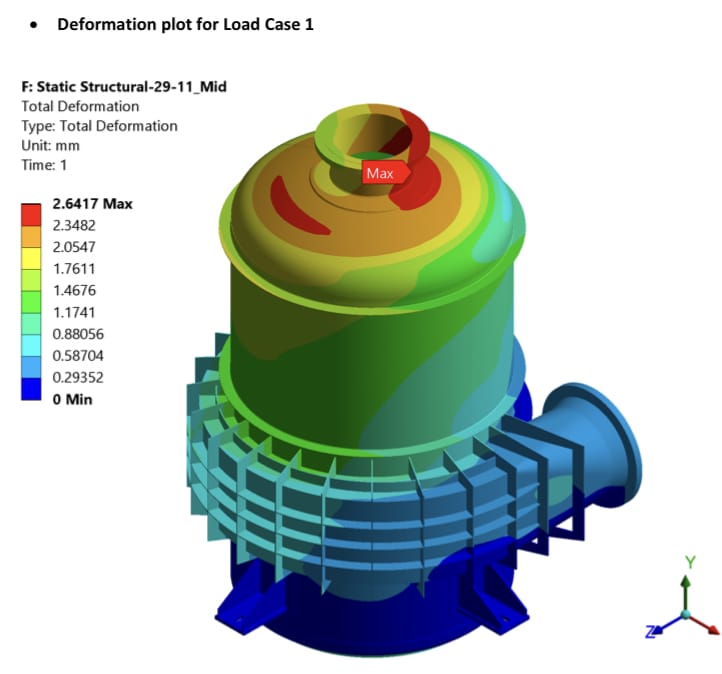
FEA outputs, such as colorful stress maps and deformation plots, can look impressive, but misinterpretation can lead to poor decisions.
How experts solve it: Translate technical results into decision-grade reports that designers, safety officers, and executives can understand and act on.
At Ideametrics, the focus is not just on running simulations, but on ensuring FEA is applied with the right physics, the right assumptions, and the right clarity, so results truly guide safer and smarter business decisions.
FEA in Compliance & Risk Management
In industries such as oil and gas, Power, Petrochemicals, and Pharmaceuticals, compliance is not optional, it’s a legal and operational necessity. Regulators and auditors demand proof that equipment is safe, reliable, and capable of withstanding real-world conditions. Finite Element Analysis (FEA) plays a critical role in meeting these requirements.
Supporting API 579 Fitness for Service (FFS)
Enabling Root Cause & Failure Analysis (RCFA)
Ensuring International Standard Compliance
Risk Reduction for Executives
The Future of FEA: AI, Cloud & Digital Twins
As industries move deeper into Industry 4.0, Finite Element Analysis (FEA) is evolving from a specialist tool into a core driver of digital transformation. Three powerful shifts will define the future of FEA:
1. AI-Driven Simulations
2. Cloud-Powered Performance
3. Digital Twins & Predictive Maintenance
For executives, these advancements mean FEA will no longer be confined to the design phase. It will become a real-time decision-making tool that improves operational reliability, reduces risk, and maximizes ROI across the entire asset lifecycle. At Ideametrics, we are already leveraging these innovations to deliver simulations that are faster, smarter, and more aligned with the future of industrial engineering.
Conclusion
In today’s industrial landscape, failure is not an option. Whether it’s a pressure vessel in the oil and gas industry, a turbine in Power Generation, or a reactor in the Pharmaceutical Sector, every component must be designed and validated with precision. Finite Element Analysis (FEA) provides that assurance, delivering predictive insights that save costs, extend equipment life, and ensure safety and compliance.
For engineers, FEA means confidence in design. For executives, it means smarter investment decisions backed by data, not assumptions. For industries as a whole, it serves as the bridge between engineering complexity and business clarity.
At Ideametrics, we combine advanced FEA expertise with cross-industry knowledge to help businesses design smarter, operate safer, and stay competitive in the global market.
Written By

PANDHARINATH SANAP
CEO and Co-Founder | IntPE
Pandharinath Sanap is the CEO and Co-Founder of Ideametrics, with more than 15 years of experience in mechanical engineering, engineering assessments, and technical reviews across industrial projects. He is an International Professional Engineer (IntPE)… Know more