
When a refinery goes down, a petrochemical process fails, or a utility system collapses, the clock starts immediately. Revenue losses compound by the hour. Safety risks escalate with every unplanned decision. Supply chains fracture downstream. And the uncomfortable truth is this most industrial facilities are simply not prepared to recover.
Not because they lack emergency response plans. But because they lack recovery engineering.
There is a critical difference between responding to a disruption and engineering your way back to safe, stable operation. Emergency response gets people out of danger. Disaster recovery engineering gets the plant back operational safely, systematically, and with full structural and process integrity.
At Ideametrics Global Engineering, this is exactly what we do. We are an engineering recovery partner for industrial facilities across Oil & Gas, Refineries, Petrochemicals, Power, Manufacturing, and Critical Infrastructure. When disruption stops your facility, we engineer the restart.
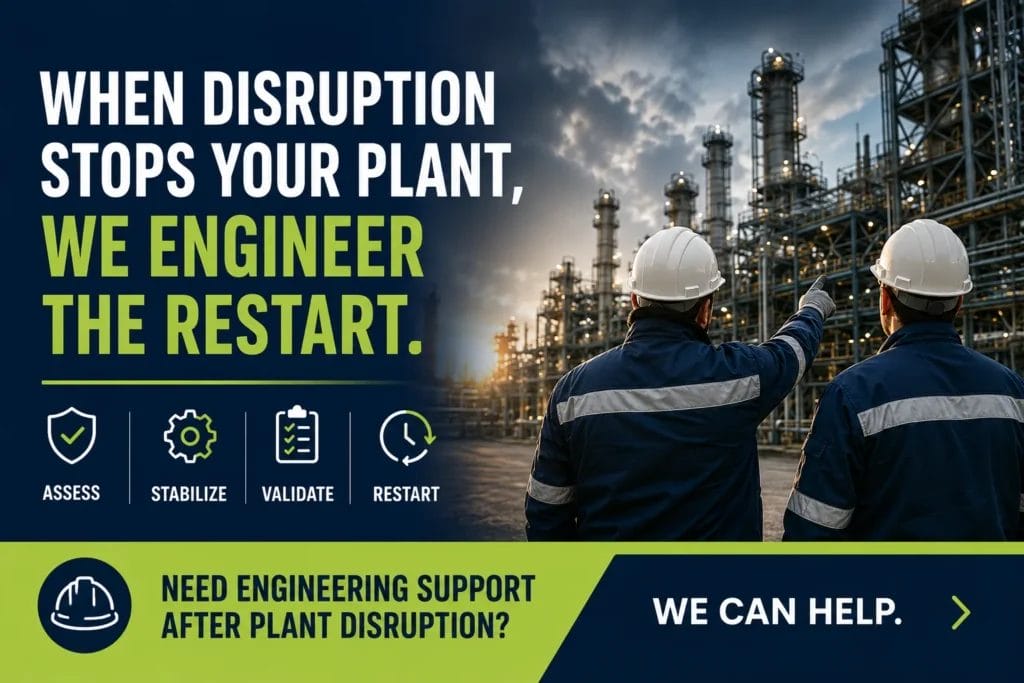
The Real Cost of Unplanned Shutdowns And Why Recovery Engineering Matters
Consider the numbers. The average hourly revenue loss during an unplanned refinery shutdown exceeds $1 million. The first 72 hours after a disruption represent the critical window, beyond which compounding damage to equipment, processes, and commercial relationships becomes exponentially harder to reverse. Yet an estimated 85% of industrial plants lack a structured, engineering-led recovery plan.
This is the gap that disaster recovery engineering services are designed to close. Without a disciplined engineering approach to recovery, facilities face a cascade of compounding problems:
Financial damage accelerates. Every hour without a structured plant recovery engineering plan means lost production, contractual penalties, and mounting repair costs. Ad-hoc recovery attempts often lead to rework, extending downtime further.
Safety hazards multiply during restart. Rushed or improvised restarts introduce some of the most dangerous conditions a plant can face, pressure surges, thermal shocks, chemical releases, rotating equipment instability, restart-critical system imbalance, and mechanical failures. Recovery must be engineered, not improvised.
Downstream supply chains collapse. A single facility shutdown can trigger failures across an entire supply chain. Customers, distributors, and dependent operations are all affected. The longer recovery takes, the deeper the commercial damage.
This is precisely why industrial disaster recovery must be treated as an engineering discipline, not a management exercise.
What Is Disaster Recovery Engineering? Defining the Discipline
Disaster engineering in an industrial context goes far beyond emergency response or business continuity planning. While emergency response focuses on life safety and hazard containment, and business continuity addresses organizational and commercial preparedness, recovery engineering operates at the systems level, assessing damage, stabilizing operations, validating integrity, and engineering the precise path back to controlled, full-rate operation.
At Ideametrics Global Engineering Disaster Recovery Engineering Services, our engineering disaster recovery services are structured around a clear engineering methodology:
- Assess damage across process, structural, and utility systems.
- Stabilize the facility and isolate compromised sections.
Validate structural and equipment integrity through engineering analysis.
Define restart readiness for each system based on validated data.
Engineer a phased return to safe, controlled operation.
Support execution until the facility is fully operational and stable.
This methodology applies whether the disruption is a fire, explosion, emergency shutdown, infrastructure failure, process upset, or utility collapse. Each demands a different recovery engineering approach, but all follow the same engineering-first principles.
Know more about Our Disaster Recovery Engineering Services
Site Recovery Engineering: From Damage Assessment to Operational Restart
Effective site recovery engineering begins the moment disruption occurs and does not end until the facility is back at stable, full-rate operation. It is a phased, dependency-driven process, not a checklist.
Phase 1 - System Failure Mapping
Every recovery starts with understanding what happened. Our engineers conduct a comprehensive assessment of the disruption, identifying what failed, what is affected, and what remains operational. This failure mapping provides the factual engineering baseline that every subsequent recovery decision depends on.
Phase 2 - Critical Dependency Analysis
Industrial facilities are complex, interconnected systems. A single failure can cascade across mechanical, electrical, process, utility, and digital systems. Our operational recovery engineering approach maps every cross-system dependency, revealing the exact sequence in which systems must be recovered to prevent cascading failures during restart.
Phase 3 - Recovery Path Design
With failure mapping and dependency analysis complete, we design the optimal recovery path an engineering-led roadmap with prioritized restart milestones, resource requirements, safety checkpoints, operational integrity validation, and process stabilization windows. This is where post-disruption recovery engineering becomes a precise, executable plan rather than a reactive scramble.
Phase 4 - Redundancy Engineering
During recovery, we also identify where redundancy planning can prevent future disruptions — alternate system pathways, backup configurations, and load redistribution strategies that reduce single-point-of-failure exposure. Our engineers also integrate strategies aligned with Redundancy Planning in Industrial Systems to strengthen long-term operational resilience engineering.
Phase 5 - Restart Simulation and Validation
Before any live restart, we simulate the recovery sequence validating restart procedures, safety interlocks, process stabilization parameters, thermal transient conditions, restart dependency sequencing, and ramp-up sequences. This simulation-first approach ensures that the actual restart is safe, controlled, and predictable. This recovery phase is closely aligned with our Restart Strategy Engineering Services for Industrial Plants approach.
Phase 6 - Phased Return to Operation
Systems are restored in the correct dependency sequence. Process stabilization is monitored. Ramp-up parameters are validated in real time. Our engineers provide continuous support until the facility reaches stable, full-rate operation. Recovery is not complete until operations are fully stable.
Why Most Industrial Recovery Efforts Fail
Many industrial recovery efforts fail not because facilities lack manpower, but because recovery begins before engineering validation is complete.
Utilities are often restarted in the wrong dependency sequence. Temporary bypasses remain active longer than intended. Thermal expansion behavior is ignored during rapid reheating. Process systems are ramped up before operational integrity validation is complete. In some cases, operations teams are pressured to accelerate restart before piping stress conditions, flare stabilization, or rotating equipment alignment are fully verified.
These failures create secondary damage during restart, often more severe than the original disruption itself.
This is why industrial operational recovery must remain engineering-led from the first assessment through final ramp-up.
Industrial Recovery Validation Framework
| Disruption Type | Engineering Risk | Recovery Validation Required |
|---|---|---|
| Refinery Emergency Shutdown | Thermal shock during restart | Thermal transient assessment |
| Utility Failure | Cascading process instability | Dependency mapping |
| Fire Damage | Structural weakening | FEA integrity validation |
| Steam System Collapse | Pressure imbalance | Utility sequencing validation |
| Rotating Equipment Failure | Critical speed instability | Dynamic startup review |
| Petrochemical Process Upset | Cross-system instability | Process stabilization validation |
| Terminal Infrastructure Damage | Load redistribution failure | Structural integrity assessment |
Operational Resilience Engineering: Building the Capacity to Recover
Recovery engineering is not only about responding after disruption. True operational resilience engineering means building the engineering infrastructure, redundancy, and organizational readiness to recover faster, before disruption occurs.
This is where proactive resilience disciplines complement reactive recovery capabilities:
Redundancy planning engineering services ensure that critical systems have alternate pathways, backup configurations, and load redistribution strategies engineered into the design, so that a single failure does not bring down the entire facility.
Single Point of Failure Identification Services maps hidden vulnerabilities across industrial systems using failure mode analysis (FMEA), fault tree analysis, and system dependency modeling, exposing weak points before they trigger an unplanned shutdown.
Business Continuity Engineering Services align engineering recovery with enterprise goals, recovery time optimization, cross-system dependency mapping, and continuity infrastructure design that directly supports revenue protection, supply chain stability, and regulatory compliance.
Critical Infrastructure Resilience Engineering Services build protection into the engineering layer for systems that cannot afford failure, power grids, water treatment, transportation networks, and communication infrastructure.
Together, these disciplines form a comprehensive operational resilience engineering framework that reduces recovery time, limits exposure, and transforms disruption from an existential threat into a managed engineering challenge.
Industrial Recovery Engineering Across Critical Sectors
Ideametrics Global Engineering delivers industrial recovery engineering and operational recovery engineering across the sectors most exposed to disruption, shutdown risk, and infrastructure damage.
Oil & Gas (Upstream, Midstream, Downstream)
Rapid restoration of production, processing, and distribution operations after shutdowns and disruptions, from wellhead to terminal.
Refineries & Petrochemical Plants
Safe restart, process stabilization, and production recovery after failure events with full engineering validation of every system before restart. Refinery restart engineering often involves restart integrity assessment, flare stabilization sequencing, exchanger thermal shock review, utility dependency restoration, and process recovery engineering under highly constrained operational conditions.
Petroleum & Chemical Plants
Restoring process integrity, safety systems, and operational continuity across complex chemical processing environments. In many petrochemical recovery scenarios, engineers must address polymer solidification, thermal runaway exposure, and cross-system instability before controlled ramp-up can begin.
Storage Terminals
Structural integrity validation, containment recovery, and safe resumption of loading and distribution operations.
Utilities & Power Plants
Rapid restoration of energy systems, grid stability, and uninterrupted supply. Utility recovery engineering often includes boiler restart stabilization, turbine synchronization validation, steam sequencing review, and operational recovery planning during phased load restoration.
Manufacturing Units
Equipment recovery, process recalibration, and controlled production ramp-up after shutdown.
Critical Infrastructure Systems
Recovery of essential services including water, transport, and communication networks.
Our experience spans refinery shutdown recovery engineering, plant shutdown recovery services, emergency plant recovery engineering, and large-scale industrial disaster recovery consulting across geographies and regulatory environments.
Engineering Analysis That Validates Recovery Decisions
Recovery decisions cannot be based on assumptions. At Ideametrics Global Engineering, every recovery engagement is backed by advanced engineering analysis to validate structural integrity, predict system behavior, and confirm restart safety before any live operation begins.
Our analytical capabilities include Finite Element Analysis (FEA) for structural and stress evaluation of damaged equipment, foundations, and steel structures; Computational Fluid Dynamics (CFD) for flow, thermal, and system behavior simulation; Piping Stress Analysis for evaluating thermal expansion, pressure, and dynamic loads after damage; Equipment Integrity Assessment using API 579 and ASME FFS methodologies; Failure and Root Cause Analysis to determine the engineering origin of failure; and System Dependency Modeling to define correct restart sequences and validate recovery logic.
This analysis-driven approach is what separates engineering-led recovery from ad-hoc restart attempts. It is the foundation of every industrial restart strategy we deliver.
Engineering Recovery Readiness Checklist
Before industrial restart begins, engineering teams should validate the following restart-critical conditions to reduce uncertainty, prevent secondary failures, and support a safe phased return to operation.
Structural Integrity
Validate critical supports, foundations, platforms, pipe racks, and load-bearing members before restart loading begins.
Thermal Expansion Paths
Confirm that piping, vessels, supports, and connected equipment have clear movement paths during heating and ramp-up.
Piping Stress Conditions
Review post-maintenance piping stress, support conditions, nozzle loads, expansion joints, and temporary repair impacts.
Utility Stabilization
Ensure power, steam, cooling water, compressed air, nitrogen, and other utilities are stable before process restart.
Temporary Modifications
Verify removal, approval, or controlled use of temporary bypasses, supports, blinds, jumpers, and emergency modifications.
Instrument Calibration
Confirm calibration and functional readiness of critical sensors, transmitters, alarms, trips, and control loops.
Rotating Equipment Alignment
Validate alignment, lubrication, vibration limits, coupling condition, and startup readiness of pumps, compressors, and turbines.
Startup Sequencing Dependencies
Confirm the correct restart order across utilities, process systems, safety systems, and downstream operating dependencies.
Safety Interlock Functionality
Test shutdown logic, permissives, alarms, emergency trips, safety interlocks, and protection systems before live operation.
Flare and Relief System Readiness
Validate flare headers, relief paths, PSV readiness, vent systems, and safe discharge capacity before process ramp-up.
Temporary Solutions and Permanent Resilience: Both Are Engineering Problems
Recovery engineering consulting requires the ability to deliver both immediate interim solutions and long-term permanent engineering. Ideametrics Global Engineering provides both from emergency stabilization through permanent redesign and resilience upgrades.
Temporary and interim engineering gets the facility to a safe, operable state as fast as engineering allows. This includes temporary structural supports, interim safe-operation strategies under defined limits, derated operation engineering, temporary utility connections, bypass configurations, and emergency piping modifications all with full engineering documentation and validation.
Permanent repair and resilience engineering restores the facility to full design capacity and makes it more resilient than before. This includes permanent structural repair and redesign, equipment replacement engineering, piping redesign and upgraded support systems, redundancy implementation for critical systems, and resilience upgrades that reduce future disruption impact.
The distinction matters: temporary solutions enable restart; permanent solutions prevent recurrence. Both require engineering discipline, and both are core to our disaster recovery engineering services.
Why Ideametrics Global Engineering for Disaster Recovery Engineering?
The difference between catastrophic loss and controlled recovery is engineering. Facilities that invest in structured recovery engineering achieve measurably better outcomes: up to 60% faster restart times compared to ad-hoc responses, 3–5× return on redundancy planning investment within the first disruption event, 90% reduction in restart-related safety incidents, and 24/7 engineering support after plant shutdown through full operational recovery.
At Ideametrics Global Engineering, we do not approach recovery as a consulting exercise. We engineer recovery, based on system dependencies, failure modes, restart criticality, load redistribution behavior, operational recovery sequencing, and integrity validation. Our teams deploy within 24 to 48 hours, providing the engineering disaster recovery services and industrial disaster recovery consulting that industrial facilities need to move from disruption to controlled operation with speed, safety, and engineering precision.
Prepare Before Disruption. Recover Faster After It.
Recovery is not a checklist. It is an engineering discipline involving structural validation, dependency sequencing, restart stabilization, process recovery engineering, and operational integrity assessment.
Whether you need a restart-readiness assessment, damage evaluation for an active shutdown, or long-term operational resilience engineering, Ideametrics Global Engineering is your engineering recovery partner.
Written By

SANGRAM POWAR
Board Chairman
Sangram Powar is the Board Chairman at Ideametrics with 15+ years of experience in mechanical engineering, design evaluation, and independent technical reviews. He is an International Professional Engineer (IntPE) and an IIT Bombay MTech graduate, bringing strong governance and engineering… Know more