
Between 2009 and 2013, US refineries experienced over 2,200 unplanned shutdowns, an average of 1.3 incidents per day. Electrical problems alone accounted for one-fifth of all refinery disruptions during that period, with power supply failures from third-party suppliers responsible for more than half of those electrical events. When Phillips 66’s Bayway refinery went dark after Superstorm Sandy in 2012, the unanticipated expenses reached approximately $56 million before tax, and that figure did not even include the estimated revenue loss exceeding $650 million from three weeks of halted production.
These are not abstract statistics. They represent the operational reality facing every oil and gas, refinery, and petrochemical facility: disruptions are not rare events, and the engineering challenge they create extends far beyond repairing what broke. The real challenge and the real risk, lies in what happens next: the restart.
Ideametrics Global Engineering acts as an engineering-led recovery and operational resilience partner for industrial facilities facing shutdowns, disruptions, equipment damage, and restart challenges.
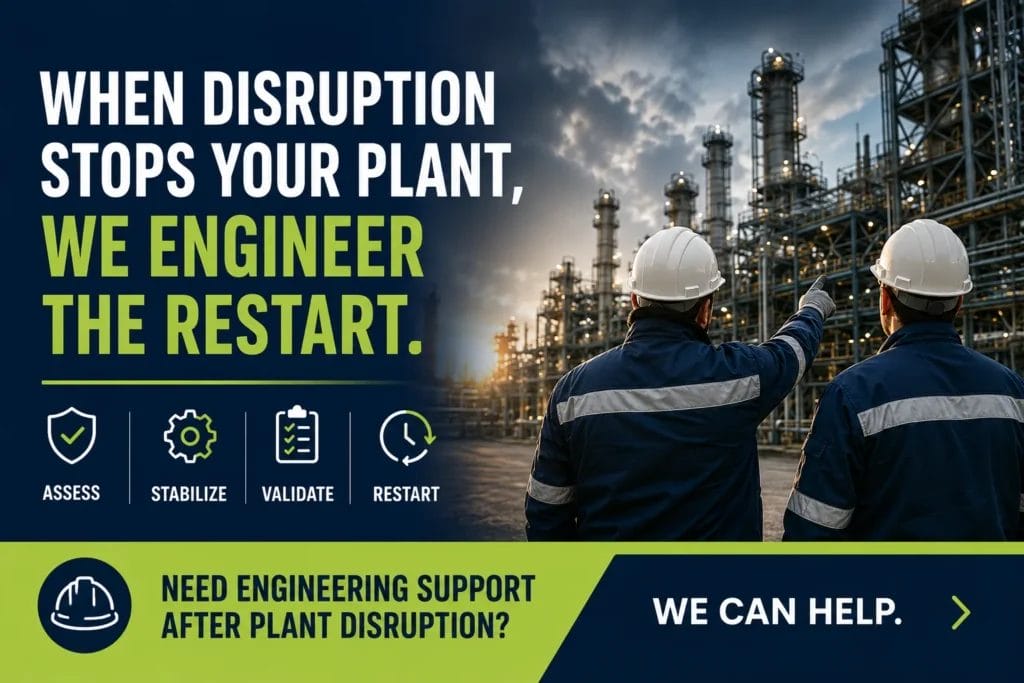
This article examines the full scope of plant recovery engineering, drawing on documented industry experience to explain why engineering validation before restart is not optional conservatism but an operational necessity.
The Hidden Danger: Why Restart Is More Dangerous Than Shutdown
When a refinery, petrochemical plant, or oil and gas facility experiences a forced shutdown, the immediate instinct is to assess damage and restore production. The commercial pressure is enormous and legitimate a single quarter of outage-related problems cost HollyFrontier an estimated $98 million across its refinery portfolio, encompassing fires at the Tulsa and Cheyenne refineries, an unplanned shutdown at the Navajo refinery, and a delayed restart compounded by a power outage at the El Dorado facility.
But the financial pressure to restart quickly is precisely what makes the restart phase so dangerous. Industry data consistently shows that the consequences of a poorly managed restart are frequently more severe than the original incident.
The reasons are thermomechanical. During an unplanned shutdown, equipment cools unevenly. Thick-walled pressure vessels, dissimilar metal welds, and components with varying wall thicknesses develop residual stress patterns that did not exist during normal operation. Piping systems designed for a specific steady-state temperature profile experience thermal contraction that can introduce loads at branch connections, equipment nozzles, and support locations that exceed original design allowables.
When that same equipment is then brought back to operating temperature during restart, the resulting thermal transients can generate stresses that exceed anything the equipment sees during normal service. This is the domain of thermal transient analysis and it is the engineering discipline that separates a validated restart from a hopeful one.
The engineering question is never simply “can we restart?” It is “what is the engineering evidence that we can restart safely, at what rate, with what hold points, and under what monitoring conditions?”
What Plant Recovery Engineering Actually Involves
Recovery engineering is not a single inspection or a maintenance clearance. It is a structured, multi-phase engineering process where each phase builds the evidence base for the next. Skipping phases does not save time it introduces unquantified risk that typically manifests as a secondary incident during or shortly after restart.
Phase 1: Damage Characterization and Extent of Condition
The first engineering task after any disruption is establishing the true extent of damage. This means going well beyond what is visibly broken to characterize what may have been compromised in ways that are not immediately apparent.
The challenge is compounded by the interconnected nature of modern refining and petrochemical operations. A power outage originating at a single utility substation can cascade across multiple facilities simultaneously. When an arc flash was observed at a utility provider’s substation north of the Port Arthur refinery hub in April 2013, it triggered shutdowns at three separate refineries operated by different companies Motiva Enterprises, Total Petrochemicals, and Valero Energy with recovery timelines ranging from one to four days. Each facility required independent damage assessment even though the initiating event was common, because the consequences manifested differently depending on each plant’s operating state, equipment condition, and shutdown sequence at the moment power was lost.
For process failures, overpressure events, runaway reactions, loss of containment, the characterization must extend to every system that experienced conditions outside its design basis. This includes not only the primary equipment involved but also relief systems, emergency shutdown devices, control systems, and interconnected process units.
Root cause failure analysis is integral to this phase, not as an academic exercise but as a direct input to recovery engineering. Understanding why the incident occurred determines which systems require the most scrutiny during recovery and what modifications may be necessary before restart. Industry experience with post-incident analysis methods including Fault Tree Analysis, Failure Mode and Effects Analysis, and Sequential Timed Events Plotting, demonstrates that the root cause frequently points to systemic vulnerabilities rather than single-component failures, and these systemic issues must be addressed before restart to prevent recurrence.
Phase 2: Fitness for Service and Remaining Life Assessment
Once damage characterization is complete, the critical engineering question becomes: can affected equipment continue to operate safely, and if so, for how long and under what conditions?
This is the domain of fitness for service assessment, conducted in accordance with API 579 assessment methodologies. API 579-1/ASME FFS-1 provides the quantitative engineering framework for evaluating equipment with known flaws, damage, or deviations from original design conditions. It enables engineers to make defensible, code-compliant decisions about whether equipment can return to service, whether it requires repair or re-rating, or whether it must be replaced.
The assessment scope depends on the incident type. Fire-exposed equipment requires evaluation for metallurgical degradation, loss of material properties at elevated temperatures, and dimensional distortion. Equipment subjected to overpressure events requires assessment for plastic deformation, fatigue damage accumulation, and potential crack initiation. Equipment where corrosion or erosion was discovered during the shutdown opportunity requires evaluation against minimum required thickness calculations and projected corrosion rates.
What makes this phase particularly valuable to plant executives is remaining life assessment. Rather than presenting a binary “pass or fail” result, remaining life analysis projects how long equipment can safely operate given its current condition and expected service environment. This transforms capital allocation decisions from reactive replacement debates into quantified engineering recommendations with defined confidence intervals and projected inspection intervals.
Ideametrics Global Engineering acts as an engineering-led recovery and operational resilience partner for industrial facilities facing shutdowns, disruptions, equipment damage, and restart challenges and fitness for service assessment is where that engineering depth most directly protects capital investment decisions.
Phase 3: Thermal and Mechanical Integrity for Startup
The startup phase introduces a unique category of engineering challenge distinct from both normal operation and the incident itself.
Thermal transient analysis becomes critical when equipment that has cooled to ambient temperature is brought back to operating conditions. The thermal gradients generated during heatup can produce stresses exceeding those seen during steady-state operation. Thick-walled reactor vessels, heat exchanger tubesheets, and dissimilar metal weld joints are particularly susceptible to thermal shock analysis scenarios when heating rates exceed the values assumed in original design calculations.
Industry experience demonstrates why this matters. Refinery emergency planning guidance developed by CONCAWE and the European petroleum industry emphasizes that the consequences of process parameter excursions temperature, pressure, and flow deviations beyond design basis can cascade through interconnected systems in ways that are not intuitively obvious. A furnace that was exposed to flame impingement during a fire event may have experienced metallurgical changes in its tube passes that are invisible to external inspection but that alter the tube’s thermal response during restart, creating the conditions for a tube failure at a moment when the furnace is most vulnerable.
Piping stress during startup presents another category of risk that demands engineering analysis, not operational judgment alone. Piping systems are designed for a specific operating temperature profile, and the thermal expansion calculations that govern their design assume a controlled, gradual temperature transition. The rapid or uneven heating that commonly occurs during startups following extended shutdowns can generate pipe movements and anchor loads that exceed design allowables, particularly at branch connections, equipment nozzles, spring hangers at cold settings, and support locations where constraints are highest.
These analyses directly determine the safe heatup rates, temperature hold points, and monitoring requirements that operations teams must follow during restart. They are not optional engineering conservatism, they are the quantitative basis for the startup procedure.
Phase 4: Startup Sequencing, Utility Stabilization, and Relief System Validation
The sequence in which systems are brought online is an engineering decision with safety implications that rival any individual equipment assessment. Startup sequencing engineering defines the order, timing, and conditions under which each system is energized, pressurized, heated, and loaded.
Industry experience from refinery operations across multiple decades demonstrates the cascading consequences of poor sequencing. Bringing a process unit online before its utility systems, steam, power, cooling water, instrument air, nitrogen, and fuel gas, are fully stabilized creates the conditions for immediate trips, process upsets, and potential equipment damage. Loading a fired heater before its combustion air system is properly balanced or before its emergency shutdown devices have been verified creates both safety and environmental hazards.
Utility stabilization engineering addresses this foundation. Modern refineries are tightly heat-integrated: the output of one unit provides heat input for another. This integration, while highly energy-efficient during normal operation, creates sequencing dependencies during startup that must be carefully mapped and engineered. The loss of any single utility during the startup sequence can trigger pressure excursions in multiple units simultaneously, and the relief system must be verified to handle the resulting loads.
This brings a critical and frequently overlooked aspect of restart engineering into focus: relief system validation. The design basis for refinery flare and relief header systems depends fundamentally on assumptions about which pressure relief valves may lift simultaneously during upset conditions. Engineering analysis from operating refineries, including experience from facilities with multiple flare systems serving crude distillation units, fluid catalytic cracking units, hydrodesulfurization units, hydrogen plants, and sulfur recovery units, demonstrates that the relief loads generated during startup scenarios can differ substantially from those assumed in the original design.
Where emergency shutdown devices are relied upon to reduce expected flare loads, their reliability under actual startup conditions must be independently verified. The integrity level of each safety interlock system, whether single-path, partially redundant, or fully redundant with voting logic, directly determines whether the relief system can handle the startup load case. This verification is particularly important for units that have been modified, debottlenecked, or expanded since the original relief system design.
Know more about Our Disaster Recovery Engineering Services
Why Restart Strategy Engineering Determines Whether Recovery Succeeds or Fails
For major refineries and petrochemical plants, the first 72 hours after disruption often determine whether recovery becomes controlled stabilization or cascading operational failure.
In real-world industrial recovery environments, emergency engineering support is rarely limited to repairing damaged equipment. The greater challenge is coordinating how interconnected systems return to operation without triggering secondary incidents. During an emergency refinery restart or a plant restart after shutdown, process systems, utility systems, flare systems, rotating equipment, and control systems all interact simultaneously under transient conditions.
Without structured restart strategy engineering, facilities frequently encounter:
- thermal instability during startup,
- unsafe pressure transients,
- flare overload conditions,
- repeated process trips,
- rotating equipment instability,
- utility synchronization failures,
- and emergency operational recovery delays.
Safe restart after fire events or emergency shutdown conditions requires more than maintenance readiness. It requires engineering-led startup dependency mapping, phased utility restoration logic, operational sequencing validation, transient load review, and quantified startup hold points based on actual system behavior.
This is why restart strategy engineering is increasingly becoming one of the most commercially critical disciplines within operational recovery engineering for oil and gas, refinery, and petrochemical infrastructure.
Why Recovery Differs Across Oil & Gas, Refinery, and Petrochemical Operations
While fundamental engineering principles apply across all industrial sectors, the specific recovery challenges vary significantly. A credible recovery engineering program accounts for these differences rather than applying a generic methodology.
Oil and Gas Recovery Engineering
Oil and gas recovery engineering presents unique challenges driven by remote locations, limited access to specialized resources, and the complex interaction between subsurface conditions and surface facility integrity. Offshore recovery engineering compounds these challenges through weight constraints on replacement equipment, crane availability windows, weather-dependent access, and the need to coordinate with marine operations and regulatory bodies.
Oil and gas shutdown recovery frequently involves wells that must be actively managed during the surface facility outage. Wells may need to be killed, secured with temporary barriers, or continuously monitored to prevent uncontrolled flow during the recovery period. The interaction between reservoir pressure, wellbore integrity, completion condition, and surface facility status creates a system-level recovery challenge that simply does not exist in downstream operations.
Refinery Recovery Engineering
Refinery shutdown recovery involves the highest degree of process integration complexity in the downstream sector. The tight heat integration of modern refineries means that startup of any single unit depends on the operating status of several others, creating sequencing puzzles that require engineering solutions rather than operational improvisation.
Refinery startup validation must account for multiple equipment-specific concerns: catalyst condition in reactors that may have been exposed to abnormal temperatures or oxygen ingress; heat exchanger networks where differential thermal expansion during cooling may have caused tube-to-tubesheet joint damage; rotating equipment that has been idle for extended periods and may require bearing inspection, alignment verification, and controlled run-in procedures.
Refinery operational recovery timelines following major disruptions are frequently measured in weeks or months. The most common equipment to fail in refinery electrical systems is transformers, accounting for approximately 35% of electrical equipment failures, ahead of substations and cables. Among processing units, sulfur recovery units experience the highest frequency of electrical problems, followed by fluid catalytic cracking units, crude distillation units, hydrocracking units, and cokers. Understanding these statistical patterns allows recovery engineering to prioritize assessment and restoration efforts where they will have the greatest impact on safe, timely restart.
Refinery resilience engineering builds on this understanding by incorporating predictive maintenance approaches, both preventive (time-based) and condition-based, into the recovery program, so that the post-recovery operating period benefits from the inspection access and data gathered during the shutdown.
Petrochemical Recovery Engineering
Petrochemical plant recovery introduces the additional complexity of chemical inventories that may have degraded, polymerized, or become hazardous during the shutdown period. Reactor systems may contain residual catalysts or intermediate products that must be safely managed before any restart activities begin. Storage systems may have experienced temperature excursions affecting product quality or creating safety hazards through decomposition or phase separation.
Petrochemical operational resilience depends on understanding these chemical-specific risks and incorporating them into the recovery plan alongside the mechanical, structural, and electrical considerations that apply to all industrial recovery scenarios.
Industrial Recovery Engineering Scenario Framework
| Disruption Scenario | Engineering Risk | Required Validation |
|---|---|---|
| Refinery Fire | Thermal damage and structural weakening | Post-fire structural integrity assessment |
| Emergency Shutdown | Thermal stress and transient loading | Thermal transient analysis |
| Utility Failure | Process instability and cascading trips | Startup sequencing engineering |
| Power Loss Event | Equipment trip loads and process upset | Operational recovery engineering |
| Flare System Event | Pressure surge and relief overload | Relief capacity validation |
| Offshore Facility Disruption | System dependency instability | Offshore recovery engineering |
| Petrochemical Process Upset | Reactor instability and material degradation | Fitness for service assessment |
Emergency Preparedness: The Foundation of Effective Recovery
The most effective recovery engineering begins before the incident occurs. Industry best practice, developed through decades of operational experience across European and global refining operations, establishes that emergency preparedness is built on two complementary strategies: risk management and crisis management.
Risk management encompasses installing reliable equipment capable of withstanding disruptions, implementing prevention techniques to detect and address problems before they cause failures, and deploying protective equipment to limit consequences when failures occur. Crisis management activates when prevention is insufficient, encompassing the recovery technologies, restart methods, and engineering validation needed to return to safe operation without repeating the failure that caused the original shutdown.
The most sophisticated emergency preparedness programs recognize that effective recovery requires pre-positioned engineering capability, not engineering capability sourced after the event under time pressure. This includes pre-incident identification of critical equipment, pre-calculated relief system capacity margins, pre-established fitness for service assessment methodologies for likely damage scenarios, and pre-developed startup sequencing logic that can be adapted to specific incident circumstances.
Ideametrics Global Engineering acts as an engineering-led recovery and operational resilience partner for industrial facilities facing shutdowns, disruptions, equipment damage, and restart challenges. This partnership model delivers its highest value when established before an incident occurs, because pre-incident engineering preparation directly determines the speed and safety of post-incident recovery.
The Executive Case for Engineering-Led Recovery
For operations directors, plant managers, and C-suite executives, the commercial pressure to minimize downtime is intense and legitimate. Industry consultancy estimates indicate that unscheduled shutdowns coupled with poor maintenance practices cost the global process industries approximately 5% of total production annually, with estimates suggesting that 80% of those losses would be avoidable through proper preventative and recovery engineering measures.
The financial impact of refinery shutdowns operates on multiple dimensions simultaneously: direct equipment repair costs, lost production revenue, excessive flaring penalties and environmental fines, potential worker safety incidents with associated legal liabilities, increased energy consumption during restart, and reputational damage from fuel supply disruptions and media scrutiny.
But the data consistently shows that facilities investing in proper operational recovery engineering before restart achieve faster return to full-rate production by eliminating the re-trips and secondary upsets that plague facilities rushing back online. The paradox of recovery engineering is that the time invested in engineering validation before restart almost always results in less total downtime than the alternative.
Refinery resilience engineering and oil and gas operational resilience are fundamentally about replacing uncertainty with engineering evidence. When an executive presents a regulator, insurer, or board with a documented engineering basis for restart, including fitness for service assessments, thermal transient analyses, piping stress verifications, startup sequencing validation, and relief system capacity confirmation, the path to approved operation is faster and more certain than when the basis is operational judgment alone.
Building Long-Term Operational Resilience
Recovery engineering addresses the immediate challenge of returning to safe operation. But its most valuable long-term output is the insight it provides for preventing future disruptions.
Every recovery reveals vulnerabilities. Single point of failure analysis conducted during the recovery process identifies equipment, systems, and configurations whose failure can cascade across an entire facility. Industry data demonstrates the pattern clearly: when a single utility substation failure can shut down three separate refineries simultaneously, the single point of failure is not the substation, it is the absence of engineering redundancy in the power supply architecture.
Critical infrastructure resilience is built through systematic identification and mitigation of these vulnerabilities, combined with pre-planned recovery strategies that can be activated immediately when disruptions occur rather than developed under the pressure of an active event. This includes evaluating whether backup power systems, generators, uninterruptible power supplies, and onsite generation capabilities including combined heat and power systems, provide adequate coverage for safety-critical systems during the period between power loss and restoration.
Operational resilience engineering also extends to the reliability of safety systems themselves. Emergency shutdown devices, safety interlock systems, and automated trip functions must demonstrate the reliability assumed in the facility’s safety case. Industry experience has repeatedly shown that the promised reliability of safety systems, even high-integrity redundant systems, has not always materialized in field service. Poor software reliability, high spurious trip rates leading to operator bypass, and extended mean time to repair for digital safety systems all undermine the safety case assumptions that underpin facility operations.
A comprehensive resilience engineering program addresses these systemic vulnerabilities alongside the immediate recovery needs, creating a facility that is not merely restored to its pre-incident condition but is measurably more resilient against future disruptions.
When to Engage Recovery Engineering Support
The optimal time to engage recovery engineering support is before an incident occurs, through pre-incident planning, emergency preparedness assessment, tabletop exercises, and resilience audits. The second-best time is immediately after an incident, before any restart activities begin.
Recovery engineering should be engaged whenever a facility has experienced fire, explosion, or significant thermal event affecting structural or pressure-containing components. It is equally critical following uncontrolled process excursions, overpressure, overtemperature, or loss of containment events, that may have taken equipment outside its design envelope. Extended unplanned shutdowns exceeding 72 hours that may have introduced abnormal thermal cycling, corrosion exposure, or equipment degradation warrant engineering assessment. Any event that may have compromised the integrity of safety-critical equipment, emergency shutdown systems, or relief system capacity requires independent engineering validation before restart.
The scope of assessment should reflect the interconnected nature of industrial facilities. A power outage affecting only the electrical supply still impacts every process unit, every safety system, every rotating machine, and every instrument and control system in the facility. The recovery engineering must address all of these systems, not just the electrical equipment that failed.
The Structured Recovery Workflow
Effective recovery follows a defined engineering workflow. Each stage builds the evidence base for the next, creating a documented, defensible path from incident to validated restart.
The process begins with incident characterization and extent of condition assessment, establishing not just what broke but what else may have been affected. Engineering teams then conduct fitness for service and remaining life evaluations using API 579 and other applicable codes and standards, providing quantified answers about equipment serviceability. Thermal transient analysis and piping stress during startup analysis provide the basis for defining safe operating envelopes during the restart phase, specifying heatup rates, hold temperatures, and pressure staging. This analytical foundation directly informs startup sequencing engineering and utility stabilization engineering plans that define the order and conditions for bringing systems online. Throughout the restart, monitoring criteria, hold-point definitions, and acceptance parameters ensure that actual conditions remain within the analyzed envelope.
This is the engineering process that transforms “we think it’s safe” into “we have demonstrated it is safe, and here is the documented basis for that demonstration.” In industries where the consequences of getting restart wrong are measured in lives, environmental damage, and hundreds of millions of dollars in losses, that difference between hope and evidence is the difference that matters.
Partnering for Recovery and Resilience
Ideametrics Global Engineering acts as an engineering-led recovery and operational resilience partner for industrial facilities facing shutdowns, disruptions, equipment damage, and restart challenges.
This positioning reflects a fundamental conviction: recovery engineering is not a commodity service that can be delivered by generic EPC companies, maintenance contractors, inspection-only firms, or general consultants. It is a specialized engineering discipline requiring deep expertise in materials behavior under abnormal conditions, structural mechanics of damaged systems, process engineering for non-steady-state operations, relief system analysis for startup load cases, safety system integrity verification, and quantitative risk assessment for restart decisions.
An engineering-led recovery partner brings the analytical depth required to make quantified, defensible decisions about equipment fitness, startup conditions, and operational limits. This is the difference between clearing equipment for service and engineering equipment for service, between operational judgment and engineering evidence.
For facilities across the oil and gas, refinery, and petrochemical sectors, the question is not whether engineering-led recovery is worth the investment. The question is whether your facility can afford to restart without it.
Ideametrics Global Engineering provides plant recovery engineering, restart strategy engineering, operational recovery engineering, industrial redundancy planning engineering, critical infrastructure resilience engineering, and disaster recovery engineering for critical industrial infrastructure including refineries, petrochemical plants, and oil and gas facilities worldwide. For emergency engineering support, pre-incident resilience planning, startup integrity validation, or urgent refinery recovery support, contact the recovery engineering team.
Written By

PANDHARINATH SANAP
CEO and Co-Founder | IntPE
Pandharinath Sanap is the CEO and Co-Founder of Ideametrics, with more than 15 years of experience in mechanical engineering, engineering assessments, and technical reviews across industrial projects. He is an International Professional Engineer (IntPE)… Know more